
70k After Tax UK: Your 2026 Monthly Take-Home, Student Loan Impact, And Tax Traps Explained
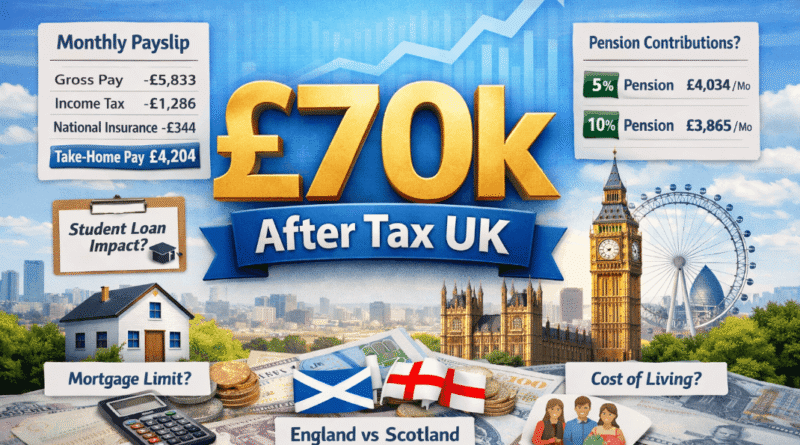
A £70,000 salary in the UK results in approximately £50,442 take-home pay per year after Income Tax and National Insurance for the 2026/27 tax year. This equates to roughly £4,204 per month or £970 per week.
Breaking the £70,000 barrier is a major career milestone, placing you comfortably in the top 10% of UK earners. However, for the current tax year, this income falls squarely into the Higher Rate bracket.
Navigating the 2026 financial landscape requires a clear understanding of fiscal drag, the ongoing freeze on tax thresholds, which means HMRC now claims a larger slice of your raises and bonuses than in previous decades.
How Much is £70,000 After Tax in the UK?
A £70,000 salary in the UK results in approximately £50,442 take-home pay per year for the 2026/27 tax year. This calculation includes deductions for Income Tax and National Insurance based on a standard 1257L tax code.
Monthly £70,000 Payslip Breakdown (2026/27)
For a standard employee in England, Wales, or Northern Ireland with a default tax code (1257L), no student loan, and a standard 5% pension contribution, the breakdown is as follows:
- Yearly Take-Home: £50,442
- Monthly Take-Home: £4,204
- Weekly Take-Home: £970
- Take-Home Percentage: 72.1% (Approximately 27.9% goes to Tax and NI)
These calculations are based on UK tax bands for the 2026/27 tax year, including current HMRC Income Tax and National Insurance thresholds.
70k Salary Take-Home Overview (2026 Estimates)
| Period | Gross Income | Income Tax | National Insurance | Net Take-Home |
| Yearly | £70,000 | £15,432 | £4,126 | £50,442 |
| Monthly | £5,833 | £1,286 | £344 | £4,204 |
| Weekly | £1,346 | £297 | £79 | £970 |
| Daily | £269 | £59 | £16 | £194 |
(Data sourced from current HMRC tax tables and Office for Budget Responsibility (OBR) fiscal projections)

Salary Comparison: How £70,000 Compares
To understand the true value of a £70k salary, it is helpful to see how it compares to surrounding brackets after the taxman takes his share.
For those anticipating future career growth, looking at the jump to an 80k salary after tax in the UK highlights how the effective tax rate continues to climb as you move deeper into the higher-rate territory.
| Gross Salary | Monthly Take-Home | Yearly Take-Home | Effective Tax Rate |
| £60,000 | £3,737 | £44,842 | 25.3% |
| £70,000 | £4,204 | £50,442 | 27.9% |
| £80,000 | £4,670 | £56,042 | 30.0% |
Hourly and Daily Rate: Breaking Down the £70,000 Milestone
For contractors or those curious about how their salary translates into time, it is useful to look at the unit price of your labor.
On a £70,000 salary, your earnings per hour are significantly higher than the UK National Living Wage (which rises to £12.71 in April 2026). Below is a breakdown of your gross and net (take-home) earnings based on a standard 37.5-hour work week and 260 working days per year.
| Time Period | Gross Earnings | Net Take-Home (After Tax/NI) |
| Hourly Rate | £35.90 | £25.86 |
| Daily Rate | £269.23 | £194.01 |
| Weekly Rate | £1,346.15 | £970.04 |
| Monthly Rate | £5,833.33 | £4,203.50 |
Expert Tip for Contractors: if you are working as an inside-IR35 contractor on a day rate, you would need a minimum daily rate of approximately £425–£450 to achieve a similar take-home pay to a £70k permanent employee, once you factor in the lack of paid holiday, sick pay, and employer pension contributions.
Detailed Tax Breakdown: The Anatomy of a £70k Salary
The UK tax system is progressive, meaning your £70,000 isn’t taxed at a single flat rate. A common misunderstanding for those moving into this bracket is that the entire amount is suddenly hit by the 40% rate; in reality, only the portion above the threshold is affected.
Tax Component Breakdown
| Tax Component | Amount |
| Personal Allowance (£12,570) | £0 (0% Tax) |
| Basic Rate (20% on £37,700) | £7,540 |
| Higher Rate (40% on £19,730) | £7,892 |
| National Insurance (8% & 2%) | £4,126 |
| Total Deductions | £19,558 |
Self-Employed Scenario
If you are self-employed, earning £70,000, your take-home pay will differ. You pay Class 2 and Class 4 National Insurance instead of employee NI.
While your headline tax may look similar, self-employed individuals can often deduct allowable business expenses before calculating taxable income, potentially retaining more of their 70k after tax UK earnings than a traditional PAYE employee.

The Pension Impact: How Contributions Affect Your 70k Take-Home
Many high earners use pension contributions to mitigate the 40% tax rate. Below is how a standard 10% contribution via Salary Sacrifice changes your real take-home pay compared to no pension.
For those who are currently earning less or planning for future salary shifts, comparing this to the net income on 50k after tax UK illustrates how much more efficient pension contributions become as you move into a higher tax bracket.
| Scenario | Gross Salary | Pension (Sacrifice) | Monthly Take-Home |
| No Pension | £70,000 | £0 | £4,204 |
| 5% Pension | £70,000 | £292 | £4,034 |
| 10% Pension | £70,000 | £583 | £3,865 |
The Reader Concern: The £70k Middle-Class Squeeze
The phenomenon of the squeezed middle has moved up the income ladder. In 2026, the psychological weight of a £70,000 salary often clashes with the mathematical reality of modern overheads.
Purchasing Power vs. The Rich Illusion
Inflation and fiscal drag have eroded the value of this milestone. While broader economic measures like the DWP 750 payment boost in June 2025 were designed to shield lower-income households from the sharpest inflationary stings, those in the higher-rate tax brackets have largely had to absorb these rising costs through reduced disposable income.
According to OBR inflation data, a £70,000 salary in 2026 has roughly the same purchasing power as £48,000 did a decade ago.
Cost of Living: Is 70k enough for a family?
In the South East of England, a single income of £70,000 for a family of four is tight. After a £1,800 mortgage payment, £500 for utilities/council tax, and £700 for groceries, the disposable portion of your £4,204 monthly take-home evaporates quickly. For many, this salary feels like maintenance rather than wealth.
Mortgage Affordability and the Housing Barrier
For a single person earning £70,000, the 4.5x salary rule remains the industry standard for borrowing. This gives you a mortgage ceiling of approximately £315,000.
- The Deposit Hurdle: To secure a competitive interest rate in 2026, a 15% deposit (£55,000) is often required for a £370,000 home. Saving this amount while paying 2026 rental prices can take a single professional several years.
- The Repayment Impact: In a higher-interest environment, a £315,000 mortgage at 4.5% results in monthly repayments of roughly £1,750. This accounts for 41% of your net monthly income, pushing many into house-poor territory.
Given the long-term commitment of a mortgage, staying informed on the UK interest rate forecast for next 5 years is essential for anyone on this salary level planning to enter the property market or remortgage in the near future.
The Stealth Deductions: Student Loans & Child Benefit
Your net figure is often much lower due to two specific stealth taxes that target the £70k bracket:
Student Loan Comparison: Plan 1, 2, 4, and 5
Your university start date and location significantly impact your 70k after tax UK result. As of April 2026, the new Plan 5 repayments are active for the first time.
| Student Loan Plan | Threshold (2026/27) | Monthly Repayment on £70k |
| Plan 1 (Pre-2012) | £26,065 | £323 |
| Plan 2 (2012–2023 Eng/Wal) | £29,385 | £305 |
| Plan 4 (Scottish) | £32,745 | £272 |
| Plan 5 (New 2023+ Eng) | £25,000 | £338 |
| Postgraduate Loan | £21,000 | £245 |
Many professionals find that the transition from 60k after tax UK to the 70k mark is the specific threshold where benefit charges and higher-rate tax began to significantly erode the “real” value of a pay rise.
- The Pay Rise Paradox: A raise from £65k to £70k might result in only £200 extra real cash per month once you factor in the increased Child Benefit repayment.
Regional Reality: England vs. Scotland
The 70k after tax UK calculation changes drastically if you cross the border into Scotland.
| Feature | England, Wales & NI | Scotland (2026/27) |
| Higher Rate Threshold | £50,270 | £43,663 |
| Higher Rate Percentage | 40% | 42% |
| Estimated Yearly Net | £50,442 | £48,250 |
Scottish residents on £70,000 take home roughly £2,200 less per year than their English counterparts, a gap often referred to as the Scottish Tax Penalty for high earners.
Dual Income vs. Single Income: The Single Earner Penalty
The UK tax system rewards two people earning moderate salaries far more than one person earning a high salary.
- Household A (Single Earner): One person earns £70,000. They have one Personal Allowance. Monthly Take-Home: ~£4,204.
- Household B (Dual Earners): Two people earn £35,000 each (Total £70,000). Neither pays 40% tax and they have two Personal Allowances. Combined Monthly Take-Home: ~£4,750.
The dual-income household is £546 per month richer despite having the exact same gross income, highlighting why £70k can feel squeezed for single-income families.

The London Commuter Calculation (Is it worth it?)
Many £70,000 roles are based in London. Before accepting a city role, you must perform the Commuter Deduction.
- The Train Ticket: An annual season ticket into London from the Home Counties can cost £6,000.
- The Net Impact: Because you pay for your commute out of after-tax income, a £6,000 ticket requires you to earn roughly £10,500 of gross salary just to break even at the 40% tax rate.
- The Verdict: A £70k London job often leaves you with less real money than a £60k local job once travel and time are factored in.
The 60% Tax Trap: A Warning for High Earners
While the 60% Tax Trap is famous at the £100,000 mark, a mini-trap exists at £70k due to the HICBC and Student Loans. If a bonus takes you from £70k to £75k, your effective tax rate can reach 66%.
Pension Contribution Example (Salary Sacrifice)
One of the most effective ways to mitigate this is through pension salary sacrifice.
- Scenario: You contribute £5,000 into your pension via salary sacrifice.
- Result: Your taxable salary becomes £65,000.
- Tax Saving: You avoid 40% tax on that £5k, securing a £2,000 tax saving that would have otherwise gone to HMRC.
Company Car vs. Cash Allowance on 70k
- The Cash Option: A £6,000 allowance is taxed at 40%, leaving you with £3,480 after tax.
- The EV Loophole: In 2026, opting for an Electric Vehicle (EV) as a company car is often more tax-efficient than taking the cash, as Benefit-in-Kind (BiK) rates for EVs remain significantly lower than the 40% income tax hit on cash.
FAQ about 70k after tax UK
How much is 70k after tax per month in the UK?
For the 2026/27 tax year, a £70,000 salary results in approximately £4,204 per month after Income Tax and National Insurance. This assumes a standard 1257L tax code for an employee in England. If you have a Plan 2 student loan, your monthly take-home pay reduces to roughly £3,899.
Is 70k after tax UK enough to live comfortably?
Yes, £70,000 is significantly above the UK median wage. Outside of London, it supports a high standard of living for a family. However, in London or the South East, high housing costs and the 40% tax bracket mean it feels more comfortable than wealthy in the current economy.
What is the hourly rate for a 70k salary?
Based on a standard 37.5-hour working week, a £70,000 gross salary breaks down to approximately £35.90 per hour. After accounting for mandatory tax and National Insurance deductions (but excluding pension or student loans), your actual take-home hourly rate is approximately £25.86 per hour.
What is the take-home percentage of a 70k salary UK?
On a £70,000 salary, you retain approximately 72.1% of your gross earnings as take-home pay. The remaining 27.9% is deducted for Income Tax and National Insurance. Note that if you contribute to a pension or repay a student loan, your final take-home percentage will be lower.
How much tax do you pay on £70k in the UK?
For the 2026/27 tax year, you will pay approximately £15,432 in Income Tax and £4,126 in National Insurance, totalling £19,558 in mandatory deductions. This figure assumes you are an employee in England, Wales, or Northern Ireland with no additional taxable benefits or pension salary sacrifice.
What is 70k after tax UK monthly with a student loan?
If you are repaying a Plan 2 student loan, your monthly take-home pay on £70,000 will be roughly £3,899. For those with a Postgraduate loan, the monthly amount drops further to approximately £3,615, as these deductions are calculated as a percentage of your gross income over a specific threshold.
Does a 70k salary affect Child Benefit payments?
Yes. Anyone earning over £60,000 is subject to the High Income Child Benefit Charge. At £70,000, you will effectively lose 50% of your Child Benefit through a tax charge. Many earners use pension contributions to lower their Adjusted Net Income below £60,000 to keep the full benefit.
Is 70k a higher-rate taxpayer salary?
Yes. In the UK (excluding Scotland), the Higher Rate of 40% starts on income above £50,270. With a £70,000 salary, the first £50,270 is taxed at 0% and 20%, while the final £19,730 of your income is taxed at the 40% Higher Rate.
How much can I borrow for a mortgage on a 70k salary?
Most UK lenders offer between 4 and 4.5 times your gross annual income. On a £70,000 salary, this gives you a borrowing capacity of approximately £280,000 to £315,000. Your final mortgage offer will depend on your deposit size, existing debts, and monthly outgoings.
What is the take-home pay for 70k in Scotland?
Due to Scotland’s devolved tax bands, a £70,000 earner pays more Income Tax than someone in England. Your yearly take-home pay in Scotland is approximately £48,250, which is roughly £2,200 less per year than the rest of the UK. This is due to the 42% Scottish Higher Rate.
What is the take-home pay for 70k with a 10% pension?
On a £70,000 salary with a 10% salary sacrifice pension, your monthly take-home pay is approximately £3,865. While this is lower than the £4,204 no pension baseline, you are building a pension pot of £7,000 per year with significant tax savings.
How much is 70k after tax with a Plan 1 Student Loan?
For the 2026/27 tax year, a £70,000 salary with a Plan 1 student loan results in a monthly take-home of approximately £3,881. Plan 1 has a lower repayment threshold than Plan 2, meaning you pay back slightly more each month.
Conclusion
Reaching a £70,000 salary is a mark of professional success, but the transition into the Higher Rate band requires a tactical approach to personal finance.
Success at this level in 2026 is less about the gross figure and more about how efficiently you manage the Single Earner Penalty and Tax Traps through smart pension planning and benefit management.
Author Bio
Sarah Halloway is a seasoned financial journalist and our lead expert on UK civil systems. With years of experience analyzing the Department for Work and Pensions (DWP), she specializes in the intersection of monetary policy and household affordability.
Sarah provides authoritative insights into Universal Credit, State Pension updates, and the long-term impact of interest rate cycles on the UK’s most vulnerable populations.